Abstract
Recent advancements in video generation has shifted from bidirectional models for short videos to autoregressive ones for ultra long video generation. Previous models, which usually use sliding window attention to restrict inference cost, lack effective memory compression and retrieval for long-term generation beyond the window size, leading to issues of forgetting and spatiotemporal inconsistencies.
To enhance the retention of historical information with a fixed memory budget, we additionally incorporate temporal recurrent neural network (RNN) layers into the diffusion transformer (DiT) model. We propose a novel Recurrent Autoregressive Diffusion (RAD) framework, which leverages recurrent blocks for memory update and retrieval and preserves local details by full attention on overlapping sliding windows, with no training and inference gap.
Experiments on Memory Maze and Minecraft datasets demonstrate the superiority for long video generation by our framework with global memory and local attention. We systematically compare LSTM, Mamba2 and TTT inside RAD, and prove frame-wise overlapping sliding window achieves better spatiotemporal consistency than chunk-wise non-overlapping windows.
Core Contributions
1. Recurrent Memory in DiT
Propose RAD: insert a temporal RNN block after spatial/temporal attention in each DiT layer to build global long-term memory.
2. Frame-wise Overlapping Window
Frame-wise overlapping sliding window autoregression to maintain local pixel consistency, eliminating train-inference mismatch.
3. Hidden-State Prefetch
Hidden-state prefetch mechanism to recover parallel attention training, solving the RNN sequential training bottleneck.
4. Systematic RNN Comparison
Comprehensive comparison of LSTM / Mamba2 / TTT on long video world model benchmarks (Memory Maze, Minecraft).
Method: Recurrent Autoregressive Diffusion (RAD)
1. Overall Architecture
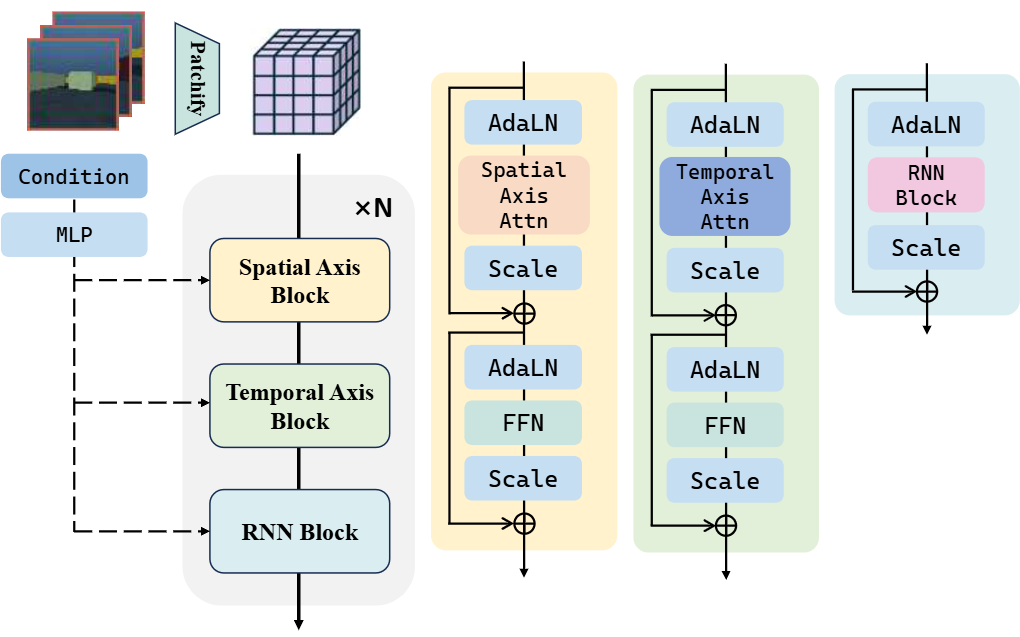
Figure 2: RAD Model Architecture — Each DiT Block contains Spatial Attention, Temporal Attention, RNN Memory Block
RAD extends standard DiT by adding an independent temporal RNN block after spatial & temporal attention in every layer:
- Spatial Axis Attention + Temporal Axis Attention with RoPE positional encoding
- RNN block only operates along temporal dimension (per-frame compression of global history)
- AdaLN inject timestep and action condition into attention and RNN layers for interactive world modeling
2. Two Autoregressive Modes
Chunk-wise Autoregression (-c)
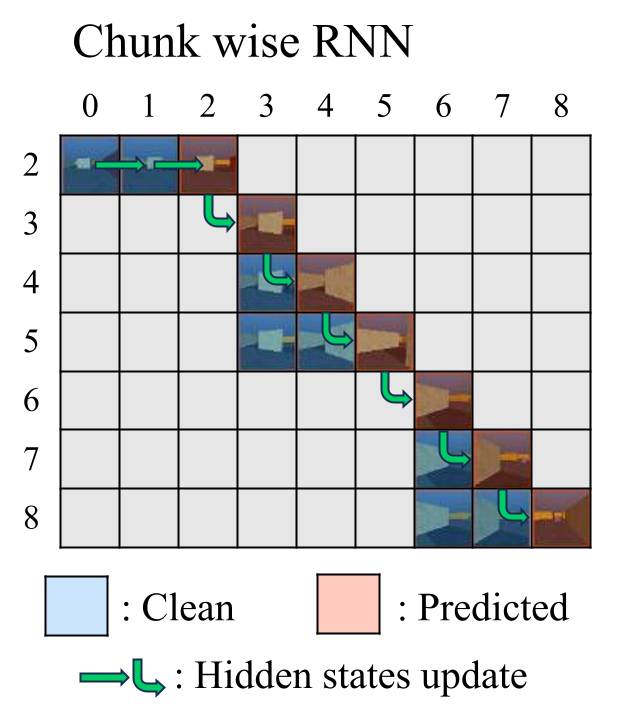
- Attention windows have no overlap between chunks
- All cross-chunk visual information must be stored in RNN hidden state
- Works well on simple low-texture scenes (Maze), fails on complex Minecraft environment
Frame-wise Autoregression (-f)
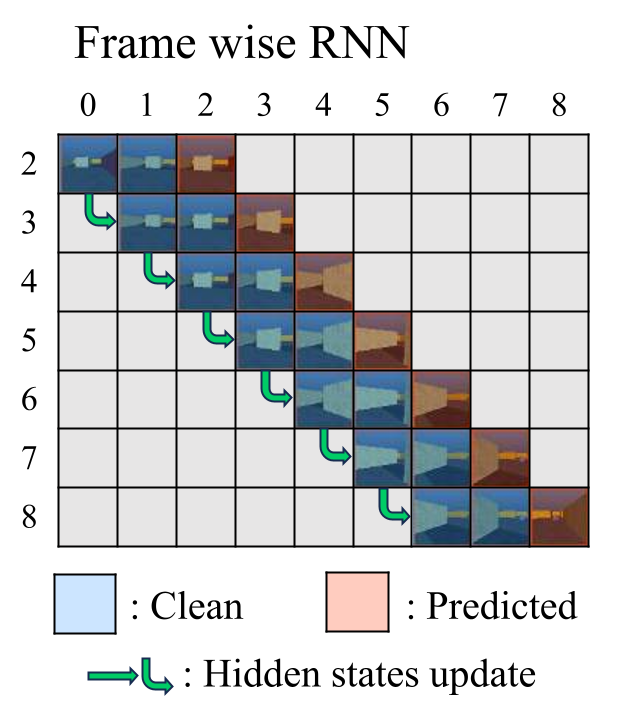
- Window slides 1 frame each step, full overlapping local attention
- Local pixel continuity transmitted via attention, RNN only stores global memory
- Consistently better PSNR/SSIM/LPIPS on all datasets, no chunk boundary artifacts
3. Hidden State Prefetch (Parallel Training)
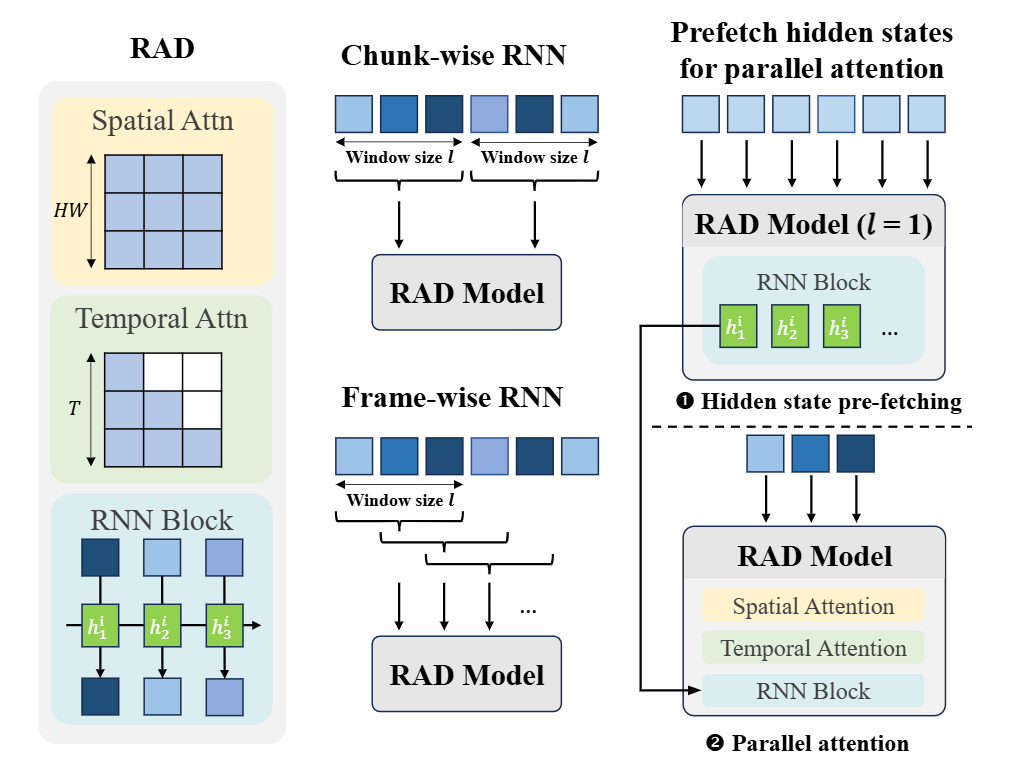
Figure 4: Prefetch vs Standard Sliding Window Training
Vanilla RNN blocks force sequential training and break attention parallelism. We precompute all RNN hidden states on clean frames in stage 1; stage 2 runs full parallel attention denoising with pre-fetched memory states.
- RNN only receives clean frames (noised latent not used for memory) → faster convergence
- Attention computation parallelized over entire sequence, huge training speedup
- Train-inference consistency: inference also uses clean hidden states after DDIM denoising steps
Algorithm 1: Inference Pipeline of Frame-wise RAD
- $\mathbf{v}_{out}\leftarrow \mathbf{x}_{1:T_c}$
- Initialize hidden states $\{h^d\}_{d=1}^D$
- # Prefill hidden states from context
- For $d=1$ to $D$DiT layer
- $h_0^d\leftarrow\mathbf{0}$
- For $t=1$ to $T_c-C+1$Frame sequence
- $\mathbf{z}_t^d\leftarrow A_d(\mathbf{x}_t)$
- $h_t^d\leftarrow R_d(\mathbf{z}_t^d,h_{t-1}^d)$
- EndFor
- $h^d\leftarrow h_{T_c-C+1}^d$
- EndFor
- # Sliding window with 1-frame stride
- While $|\mathbf{v}_{out}|< T$Frame sequence
- Sample $\epsilon\sim\mathcal{N}(0,\mathbf{I})$
- $\mathbf{z}\leftarrow \mathrm{cat}(\mathbf{v}_{out}[-C+1:],\epsilon)$
- For $k=1$ to $K$Denoising step
- For $d=1$ to $D$DiT layer
- $\mathbf{z}^d\leftarrow A_d(\mathbf{z})$
- $\mathbf{z},\hat{h}^d\leftarrow R_d(\mathbf{z}^d,h^d)$
- EndFor
- $\mathbf{z}\leftarrow \mathrm{DenoiseStep}(\mathbf{z},k)$
- EndFor
- $h^d\leftarrow \hat{h}^d,\ d=1,\dots,D$Clean hidden state
- $\mathbf{v}_{out}\leftarrow\mathrm{Append}(\mathbf{v}_{out},\mathbf{z}_{-1})$
- EndWhile
Algorithm 2: Training Pipeline of Frame-wise RAD
- Initialize hidden bank $\mathbf{H}\leftarrow\emptyset$
- # Prefetch hidden states with 1-frame RAD
- For $d=1$ to $D$DiT layer
- $h_0^d \leftarrow \mathbf{0}$
- For $t=1$ to $T$Frame sequence
- $\mathbf{z}_t^d \leftarrow A_d(\mathbf{x}_t)$
- $h_t^d \leftarrow R_d(\mathbf{z}_t^d,h_{t-1}^d)$
- $\mathbf{H}[d,t]\leftarrow h_t^d$Clean state
- EndFor
- EndFor
- # Train RAD on full sequence
- $\mathbf{z}=\mathbf{x}+\epsilon,\ \epsilon\sim\mathcal{N}(0,\mathbf{I})$
- For $d=1$ to $D$DiT layer
- $\mathbf{z}^d\leftarrow A_d(\mathbf{z})$Parallel attention
- $\mathbf{z}\leftarrow R_d(\mathbf{z}^d,\mathbf{H}[d,:])$Parallel RNN
- EndFor
4. RNN Module Comparison (LSTM / Mamba2 / TTT)
| Module | FLOPs | Params | Chunk-wise Performance | Frame-wise Performance |
|---|---|---|---|---|
| LSTM | O(BHWL(dh+h²)) | 195M | Best | Strong |
| Mamba2 | O(BHWLdn) | 153M | Poor | Comparable |
| TTT-linear | O(BHWL(d²+C)) | 118M | Poor | Comparable |
LSTM separates short-term hidden output yₜ and long-term cell state Cₜ, which makes it superior when attention cannot cross chunk boundaries. With overlapping frame-wise windows, three RNN variants perform nearly identically.
Video Visualization Results
Each sample shows a 4×2 grid: the top row is chunk-wise generation and the bottom row is frame-wise generation, each compared across the Mamba2, TTT, and LSTM recurrent modules, alongside the shared ground-truth reference.
Experimental Results
Datasets & Evaluation Metrics
- Memory Maze: 30k train videos (1000 frames each), test set 200 videos (100–300 frames), agent round-trip path memory test
- Minecraft MineRL: 20k train 1200-frame gameplay videos, test set with rotation & complex geometry scenes
- Metrics: PSNR (↑), SSIM (↑), LPIPS (↓), VBench temporal consistency / flicker / motion smoothness
- Baselines: Diffusion Forcing, Teacher Forcing, VRAG, LaCT (TTT-c)
1. Memory Maze Quantitative Results
| Model | RNN Type | PSNR | SSIM | LPIPS |
|---|---|---|---|---|
| DF | None | 14.73 | 0.32 | 0.51 |
| VRAG | None | 15.55 | 0.41 | 0.43 |
| RAD | LSTM-c | 15.64 | 0.43 | 0.47 |
| RAD | LSTM-f | 15.50 | 0.41 | 0.45 |
2. Minecraft Quantitative Results
| Model | RNN Type | PSNR | SSIM | LPIPS |
|---|---|---|---|---|
| DF | None | 15.65 | 0.45 | 0.53 |
| VRAG | None | 16.11 | 0.49 | 0.50 |
| RAD | LSTM-c | 14.24 | 0.39 | 0.55 |
| RAD | LSTM-f | 16.59 | 0.46 | 0.46 |
3. Computational Resource Analysis
| RNN Block | GPU Mem (GB) | Train Step Time (s) | Params (M) |
|---|---|---|---|
| LSTM | 10.0 | 3.7 | 195 |
| Mamba2 | 11.1 | 3.6 | 153 |
| TTT | 16.0 | 12.9 | 118 |
TTT has severe training speed overhead; LSTM achieves balanced memory and runtime cost despite larger parameter count. Prefetch stage overhead only accounts for ~17.5% total FLOPs.
Ablation Studies
1. Clean vs Noised Memory Frames for RNN
| Memory Input | PSNR | SSIM | LPIPS |
|---|---|---|---|
| Noised Latent Frames | 14.70 | 0.38 | 0.52 |
| Clean Frames (Ours Prefetch) | 15.30 | 0.41 | 0.50 |
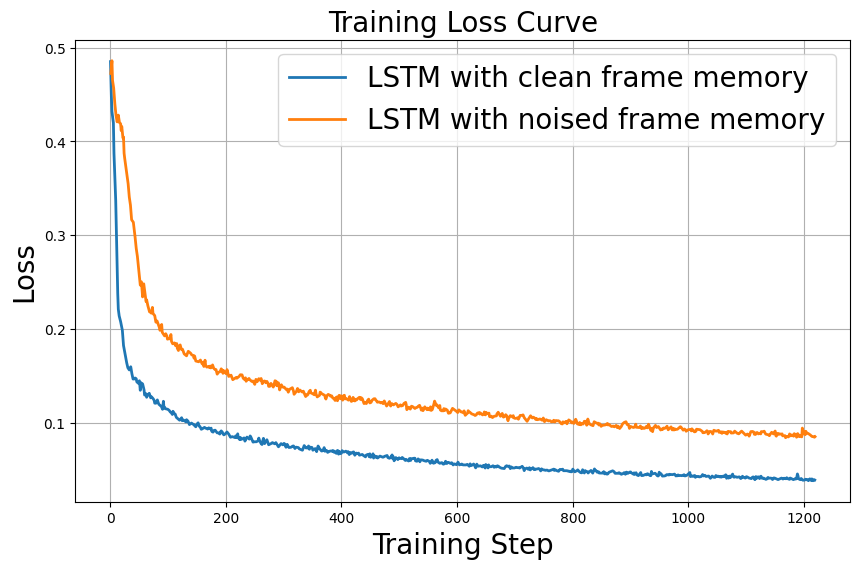
Feeding denoised noisy latents into RNN damages memory encoding; clean frame prefetch is critical for stable long-term memory.
2. Partial Overlap Chunk Ablation
| Mode | Window Stride | PSNR | SSIM | LPIPS |
|---|---|---|---|---|
| LSTM-c Full Chunk | 20 | 15.64 | 0.43 | 0.47 |
| Partial Overlap | 10 | 15.06 | 0.40 | 0.55 |
| LSTM-f Frame-wise | 1 | 15.50 | 0.41 | 0.45 |
Partially overlapping windows cannot reach performance of full frame-wise stride=1 sliding attention.
Citation
@misc{chen2025recurrentautoregressivediffusionglobal,
      title={Recurrent Autoregressive Diffusion: Global Memory Meets Local Attention},
      author={Taiye Chen and Zihan Ding and Anjian Li and Christina Zhang and Zeqi Xiao and Yisen Wang and Chi Jin},
      year={2025},
      eprint={2511.12940},
      archivePrefix={arXiv},
      primaryClass={cs.CV},
      url={https://arxiv.org/abs/2511.12940},
}